
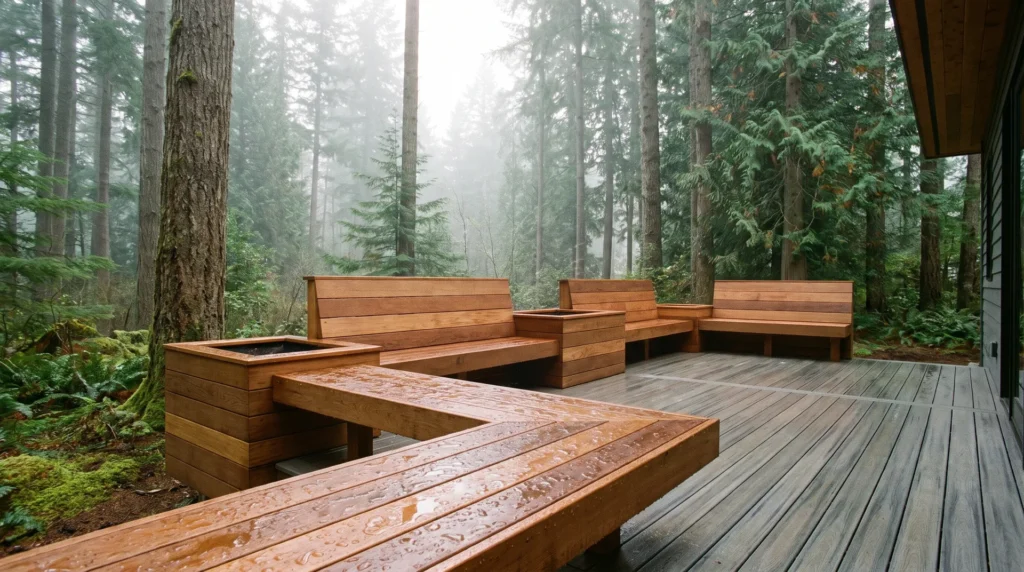
Metro Vancouver’s temperate coastal rainforest climate puts residential exterior carpentry to the test. A deck’s true lifespan is governed by two separate timelines: the durability of the surface material and the survival of the structural framing underneath. With annual rainfall ranging from roughly 1,150 mm near the coast to over 2,400 mm in North Shore neighbourhoods across 150 to 175 rainy days per year, poorly detailed structures often fail prematurely. Whether you are budgeting for a renovation or hiring a professional deck building contractor, understanding realistic longevity benchmarks for cedar, composite, and vinyl materials helps determine the long-term value of your outdoor space.
What Impacts Deck Longevity in Coastal British Columbia?
Wood does not rot simply because it gets wet; it rots because it cannot dry out. In Vancouver, low solar radiation and continuous dampness between October and April keep shaded outdoor framing trapped above a 20% wood moisture content threshold for months at a time, which activates aggressive wood-decaying fungi.
According to data from the FPInnovations Vancouver Test Site, the region carries a high decay hazard rating. A common reason modern decks fail in this climate is a mismatch between surface durability and framing protection. While many surface materials are engineered to last decades, factory pressure treatment typically penetrates only the outer shell of the lumber. When cuts or fastener penetrations leave the inner wood core exposed to trapped water, the frame can begin decaying within 7 to 12 years. Homeowners who want their decks to last must understand why structural components trap moisture and how proper drainage detailing prevents it.
Western Red Cedar Deck Lifespan and Care
A Western Red Cedar deck in Vancouver typically lasts 15 to 20 years with consistent maintenance, and up to 25 years when sheltered by an overhead cover. Native to British Columbia, cedar heartwood contains natural oils and tannins that help resist decay and insects while providing a lighter structural load than many synthetic alternatives.
However, heavy coastal rain gradually leaches out these natural oils. Unmaintained cedar decks in damp, shaded yards can develop soft rot within 8 to 12 years. A critical maintenance rule for coastal homeowners is to avoid thick, film-forming solid paints, which can trap moisture wicking up from the underside of the boards and accelerate decay. Instead, cedar generally benefits from cleaning and resealing with a penetrating oil or semi-transparent stain every 12 to 24 months, depending on sun and rain exposure.
What to Expect from a Cedar Deck Builder in Vancouver?
An experienced cedar deck builder in Vancouver does more than lay boards; they design the structure so it can dry out between coastal rainstorms. Key construction practices include spacing boards to allow drainage and seasonal movement, using stainless steel fasteners to prevent dark iron-tannin staining, installing flashed and spaced ledger connections, and adding overhead patio covers where appropriate to shield the timber from UV rays and winter rain. SpringVan Carpentry builds and renovates custom cedar decks across the Lower Mainland with a focus on durable structural framing and tailored exterior design.
Capped Composite Deck Lifespan and Care
Capped composite deck boards typically last 25 to 35 years in the Metro Vancouver climate. Unlike early uncapped composites that were more prone to absorbing moisture and developing mold, modern capped boards feature a polymer shell designed to resist water intrusion and eliminate routine sanding and staining.
The primary vulnerability of a composite deck is that it operates as a drain-through system. Rain passes through the gaps between boards and settles on the wooden joists below. Because synthetic boards outlast unprotected timber, an untreated or unsealed wood frame often becomes the limiting factor after 10 to 15 years.
What Makes a Qualified Composite Deck Builder in Vancouver?
Because capped composite decking can last 25 to 35 years, a qualified composite deck builder in Vancouver must pair the boards with a substructure built to last just as long. Best practices include spacing joists according to the manufacturer’s span ratings (typically 12 to 16 inches on center) to prevent board flex, applying butyl flashing tape over the tops of joists, sealing cut ends of pressure-treated lumber, and using corrosion-resistant galvanized or stainless steel hardware. SpringVan Carpentry works with composite brands such as Trex and TimberTech to build and resurface decks across Vancouver’s Lower Mainland.
Vinyl Membrane Deck Lifespan and Care
A well-installed vinyl deck membrane typically lasts 15 to 25 years in Vancouver. Sheet-applied PVC membranes act as both a walkable surface and a waterproof roof assembly, making a waterproof membrane required when a deck sits directly above an enclosed living space, a garage, or a dry patio.
Vinyl membranes rarely fail in the middle of a welded seam. When premature failures occur within 5 to 10 years, they usually start at wall terminations, door thresholds, guardrail post penetrations, or flat areas where poor substrate slope allows wind-driven rain to wick behind the membrane.
How to Choose a Vinyl Deck Contractor in Vancouver?
When hiring a vinyl deck contractor in Vancouver for a sundeck or balcony over living space, the most important work happens before the membrane is installed: framing a positive drainage slope (typically 1% to 2% away from the building), repairing rotted joists or ledgers, and properly detailing wall terminations and perimeter-mounted guards. SpringVan Carpentry provides structural framing, deck repairs, and vinyl deck installations using systems such as Weatherdek and DekSmart to help waterproof sundecks perform reliably in coastal British Columbia rain.
Critical Structural Details to Extend Deck Life
Findings highlighted in the BC Housing Illustrated Guide for Building Safe and Durable Wood Decks and Balconies show that poor ledger-to-house connections and unchecked moisture decay are leading causes of structural deck failures. Extending your deck’s lifespan depends on four core moisture-management details:
-
Proper Ledger Attachment and Flashing: Exterior structural framing exposed to precipitation should use pressure-treated lumber, and ledger boards must be secured with structural lag screws or through-bolts rather than nails. Integrating metal cap flashing behind the building envelope membrane and adding drainage spacers on open-joint decks helps prevent water and debris from sitting trapped against the house rim joist.
-
Corrosion-Resistant Hardware: Modern pressure-treated lumber uses copper-based preservatives that accelerate corrosion in standard zinc-plated screws. Hot-dipped galvanized or stainless steel fasteners and connectors are essential for long-term structural integrity, particularly near saltwater.
-
Concrete Pier Isolation: Wood support posts are far more vulnerable to rot when buried in wet soil or cast directly into concrete. Anchoring posts on elevated galvanized steel bases above concrete footings keeps the end grain out of standing water.
-
Under-Deck Ventilation: Low-profile and ground-level decks need adequate clearance above grade, paired with gravel and breathable landscape fabric, so cross-ventilation can dry the framing joists.
If your existing structure feels soft underfoot or shows signs of separation at the house wall, having a carpenter inspect for hidden framing decay and ledger issues early can prevent costly structural damage.
Is Upgrading Your Deck Worth the Cost?
Exterior improvements consistently rank among the strongest remodeling projects for resale value. According to the 2025 Zonda Cost vs. Value Report, a wood deck addition recoups roughly 95% of its construction cost at resale on average, while a composite deck addition recoups about 89%, though actual returns vary by property and local market conditions.
When evaluating the 10-year to 25-year total cost of ownership, cedar and composite often narrow their initial price gap over time. While a cedar deck generally costs less upfront to build, ongoing cleaning and staining add recurring material or labour costs every 1 to 2 years. Composite decking requires a higher initial investment but needs only periodic washing with mild soap and water over its service life.
Conclusion: Building for the Coast
A deck in Metro Vancouver is only as resilient as the framing beneath it and the care taken during installation. By selecting materials suited to your yard’s sun and rain exposure and prioritizing moisture-shedding construction details, you can help your outdoor space withstand decades of coastal weather. When you are ready to plan a new build or renovation, explore SpringVan Carpentry’s custom deck design and building services to work with a team dedicated to durable, well-crafted outdoor living spaces.