
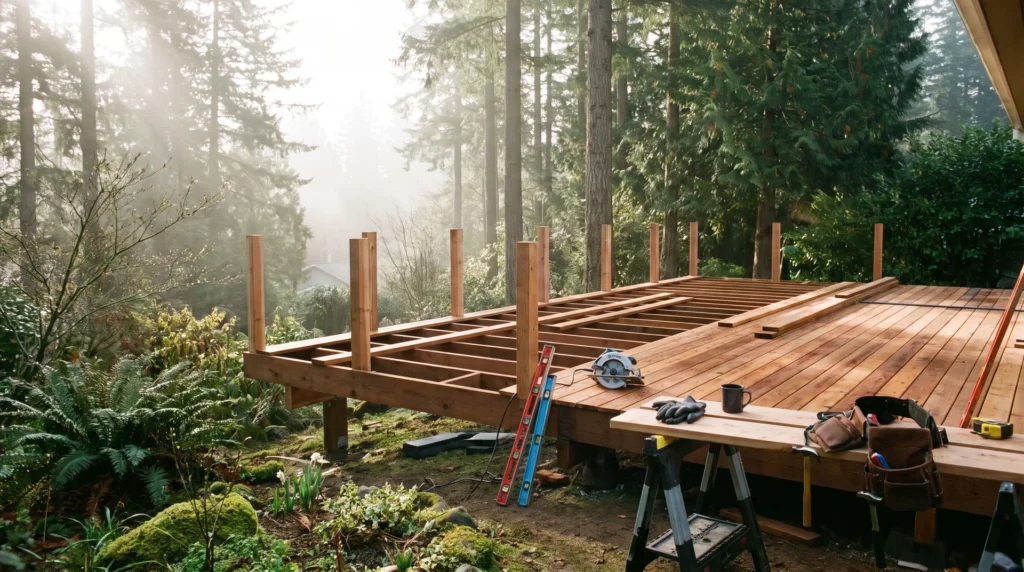
While many homeowners wait until the first sunny weekend in May to contact Vancouver deck builders, late winter and early spring are often the most strategic times to start planning and building. Between January and April, ground conditions at typical Lower Mainland elevations generally remain unfrozen, allowing for early excavation and framing. Initiating design and permit applications in January or February gives homeowners a strong chance of wrapping up construction by April, delivering a completed outdoor living space before the May long weekend.
Why Late Winter and Early Spring Are the Best Times to Build
In Metro Vancouver, starting a deck project in late winter (January to February) for design and permitting makes it possible to target March or April for construction. Because Lower Mainland soil rarely freezes deep enough to halt digging, footings and structural framing can usually be installed in early spring. This schedule helps homeowners avoid peak summer contractor backlogs and have their deck ready before the May long weekend.
Unlike much of Canada, where deep ground frost halts exterior excavation from November to April, Vancouver has a temperate coastal climate. According to Environment and Climate Change Canada climate data, Greater Vancouver experiences a long frost-free season, and at typical residential elevations, the soil rarely freezes hard enough to prevent digging and pouring concrete footings during winter.
Instead of ground frost, winter and early spring deck construction in Vancouver is primarily managed around rainfall. Selecting low-maintenance composite decking and moisture-protected framing allows experienced local contractors to build between weather systems without waiting for warm summer temperatures to apply wood stains or sealers.
The Hidden Bottleneck: Municipal Permits and Timelines
A common misconception is that a deck project takes only a week or two from the initial phone call to completion. While on-site carpentry for a straightforward residential deck often takes several days to two weeks depending on size and complexity, the complete timeline from initial consultation and design through permitting and final inspection frequently spans several weeks to a few months.
The primary driver of this pre-construction timeline is municipal permitting. Across Metro Vancouver municipalities, decks elevated more than 600 mm (24 inches) above grade, as well as decks with roof covers or structural attachments, generally require a building permit. Even for lower-complexity residential renovations in the City of Vancouver, permit review commonly takes several weeks (Side Street Vancouver), and turnaround times across surrounding municipalities such as North Vancouver, Burnaby, and Coquitlam vary based on seasonal application volume, site slope, and engineering requirements. Property owners should account for local zoning and building by-law reviews during the planning phase to avoid unexpected schedule delays.
Season-by-Season Guide for Vancouver Deck Construction
Late Winter (January to February)
Late winter is an effective window for design, engineering, and permit submissions. Contractor availability is typically higher than in peak summer, allowing for unhurried design consultations. Because the ground at lower elevations remains unfrozen, early footings and framing can often begin between storm systems. Builders must use proper wet-weather site protection and allow extra time for concrete footings to cure in cooler temperatures, as January is one of Vancouver’s wettest months (Extreme Weather Watch).
Early Spring (March to April)
Early spring serves as a primary construction window for custom carpentry. Average rainfall generally trends lower from February through April compared to peak winter months, and milder temperatures support outdoor carpentry. Projects pre-booked for this window are well positioned to wrap up before the May long weekend.
Late Spring and Summer (May to August)
Summer offers the driest weather and long daylight hours, which is optimal for applying wood stains, sealers, and vinyl deck membranes. However, this is when wait times for reputable contractors are longest. Municipal permit turnarounds slow down due to volume, and construction disrupts your ability to use your yard during the best weather of the year.
Early Fall (September to October)
Early fall acts as a second strong window for construction. The soil remains relatively firm and dry following the summer months, working temperatures are mild, and contractor schedules often open up after the summer rush. Completing structural work before late October’s heavier autumn rains sets up the yard for immediate use the following spring.
Material Considerations and Project Value
According to Statistics Canada’s Residential Renovation Price Index, deck installation prices in Vancouver have risen substantially over recent years alongside skilled trade labour rates and material costs. Because construction costs trend upward over time, delaying a project rarely results in lower pricing. Total project investment varies significantly based on deck size, elevation above grade, site access, foundation engineering, and railing selection (RenoIntel Research).
Material selection affects both upfront budget and seasonal scheduling:
-
Pressure-Treated Lumber: Offers the lowest upfront material cost and suits structural framing or budget-conscious builds, though it requires periodic staining and sealing during dry weather to limit checking and moisture damage.
-
Western Red Cedar: A classic coastal BC wood naturally suited to outdoor applications. Installing cedar in spring allows the wood to acclimate gradually before peak summer heat, though protective finishes still require dry weather.
-
Composite Decking (such as Trex, TimberTech, or Fiberon): Carries a higher initial material cost than softwood lumber, but capped composite boards resist moisture absorption and rot. Because they require no staining or sealing, they are well suited for late winter and early spring installation.
Beyond expanding usable outdoor living space from spring through autumn, a well-built deck can also support property resale appeal. Industry remodeling analyses, such as the Zonda Cost vs. Value Report cited by Realty Today, consistently rank outdoor deck additions among the exterior renovations that recoup a high share of their construction cost at resale, though actual return depends on local market conditions, build quality, and how well the design fits the property.
How to Choose a Custom Deck Builder in Vancouver
When evaluating a custom deck builder in Vancouver, homeowners should look for comprehensive service area coverage, specific structural capabilities, and a clear design process. A true custom builder differs from a general handyman through their ability to handle site-specific engineering for sloped terrain (such as the hillsides of North Vancouver and Burnaby) and strict compliance with the Vancouver Building By-law (VBBL).
SpringVan Carpentry is a Vancouver-based residential carpentry and construction company specializing in custom decks, deck renovations, pergolas, and outdoor living structures across the Lower Mainland. Because coastal rainforest conditions demand careful moisture management, working with a builder that prioritizes proper ledger flashing, ventilation, and substructure drainage helps protect against premature rot and structural decay. By focusing on durable, low-maintenance custom deck design and construction, SpringVan Carpentry delivers trade-level craftsmanship with clear communication from planning through completion.
When to Book a Deck Builder in Vancouver
Booking a deck builder in Vancouver works best with a reverse-engineered schedule based on your target completion date. Waiting until May to contact a builder often means contending with peak-season contractor queues and permit review backlogs, which can push construction into mid-to-late summer.
Follow this booking calendar to optimize your project timeline:
-
For a deck ready by the May Long Weekend: Contact a builder in January or February. This provides lead time for design consultations, municipal permit review (where required), and material ordering ahead of a March or April build phase.
-
For a deck ready by July or August: Begin design and permitting in March or April before summer schedules fill up.
-
For an unhurried off-peak build: Schedule your consultation in September or October to take advantage of early fall building conditions.
Whether you are planning to install low-maintenance composite boards, a classic Western Red Cedar deck, or an overhead pergola to extend your outdoor season, starting early helps keep your project on schedule. Homeowners ready to begin planning before the spring rush can reach out to SpringVan Carpentry to discuss design options and secure a spot in the late winter or early spring construction queue.