
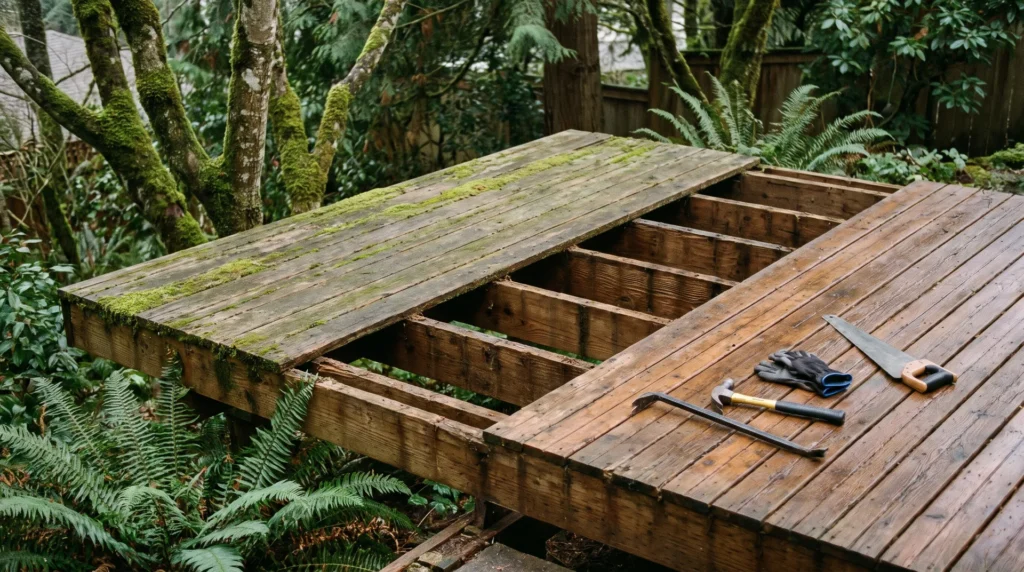
In Metro Vancouver’s temperate coastal rainforest climate, outdoor timber structures endure relentless moisture cycling, freeze-thaw events, and biological decay. Homeowners evaluating an aging deck face a tough choice: repair localized damage, resurface the existing frame, or tear everything down and start fresh. Because cosmetic surface wear often looks dramatic while catastrophic structural rot hides beneath the boards, homeowners frequently misdiagnose the scope of work they actually need. This guide provides a contractor-grade decision framework to help you assess your deck’s true condition before hiring a deck building contractor.
Hiring a Deck Builder in Vancouver: What Should You Look For?
A deck builder in Vancouver is a specialized exterior carpenter who engineers structures to withstand the Pacific Northwest climate by utilizing proper moisture management, continuous ledger flashing, and code-compliant foundations.
Finding the right expert is critical because the structural lifespan of a wood deck frame depends heavily on climate and moisture exposure. According to the North American Deck and Railing Association (NADRA), more than half of outdoor structures in North America have passed their safe service life. In coastal environments where wind, rain, and moisture accelerate decay, delayed maintenance can be costly. Water running off a single spongy surface board can rot the load-bearing joist beneath it, turning an inexpensive board replacement into a major structural rebuild.
What is a Structural Deck Assessment?
A structural deck assessment is a comprehensive evaluation of a deck’s load-bearing substructure, focusing on the ledger board connection, joist integrity, and foundation stability rather than just the cosmetic surface.
A contractor-grade deck inspection starts from the ground up: checking concrete footings for frost heave or soil settlement, probing posts and beams for moisture decay, verifying that the house ledger board is properly bolted and metal-flashed rather than nailed, and measuring joist spacing and plane flatness before ordering any decking materials.
Homeowners learning to identify hidden substructure decay beneath cosmetic surfaces often discover that a thorough physical inspection is the only reliable way to choose the right intervention path.
The 3-Tier Decision Framework
Tier 1: Localized Repair and Refinishing
Repairing isolated sections is generally practical when the substructure (ledger board, beams, posts, and footings) is still structurally sound, level, and free of widespread rot. This approach fits best when surface wear is limited to a small portion of the deck boards and joist damage is isolated to one or two members with minor decay.
When repairing joists, specific structural constraints apply. As outlined in the Trex Protect Building Code Guide, sistering a new joist alongside a damaged one requires fastening it with staggered structural screws or bolts. To restore load capacity, a sistered joist typically needs to extend well past the damaged area and bear fully on the same sound beam and ledger connection points. If structural rot is extensive or the bearing points are compromised, full member replacement is required.
Tier 2: Resurfacing (Redecking) an Existing Frame
Resurfacing involves stripping all surface deck boards and railings while preserving a structurally sound substructure.
In Metro Vancouver’s coastal rainforest climate, resurfacing an aging deck only makes financial sense if the underlying framing, ledger connection, and concrete footings can outlast the new surface boards.
Homeowners should watch out for the “composite redecking trap.” Many modern capped composite or PVC boards carry warranties of 25 to 50 years. Installing long-lasting boards over a deteriorating wood frame means the substructure can fail well before the surface wears out, which is why proper moisture management and flashing under composite boards are essential.
Additionally, older wood decks were often framed with joists spaced at 16 inches or 24 inches on-center (OC). Because composite boards flex more than solid dimensional lumber, many manufacturers require maximum spacing of 16 inches OC for straight lays and 12 inches OC for diagonal installations or picture-frame borders.
Tier 3: Full Tear-Down and Rebuild
A complete rebuild is necessary when the structure poses a safety hazard. A primary failure point is the ledger board. Industry safety summaries from NADRA and InterNACHI report that roughly 90% of catastrophic deck collapses involve failure of the house-to-deck ledger board connection, often because the ledger was attached with nails only or lacked proper metal flashing.
Other triggers for a full rebuild include:
-
Widespread Decay: A probe or awl sinks easily into multiple joists, posts, or the main drop beam.
-
Failing Foundations: Concrete piers are heaving, sinking, or resting directly on topsoil.
-
Unsafe Guardrails: Older notched 4×4 guard posts lose up to 75% of their rotational strength when notched to half their thickness, making them a serious fall hazard (NADRA).
If you discover fundamental flaws in how the structure is attached to your home, bringing in a reliable contractor for house repair and structural upgrades is the safest path forward.
What Does a Deck Renovation Contractor in Vancouver Do?
A deck renovation contractor in Vancouver is a structural carpentry specialist who evaluates whether an existing substructure can be saved, executes complex framing retrofits, and ensures all work complies with the Vancouver Building By-law (VBBL 2025).
Navigating local codes is a primary reason to hire a professional. The City of Vancouver operates under its own strict regulations compared to the 2024 BC Building Code used in neighboring municipalities.
Under the City of Vancouver’s 2025 Building By-law (VBBL), swapping out a few weathered deck boards in-kind counts as minor non-structural maintenance, whereas replacing load-bearing beams, altering deck framing, or performing structural repairs requires a formal building permit.
Working without the required approvals can lead to stop-work orders, insurance complications, and municipal penalties that can double the standard permit fee. Understanding local building permit triggers before starting structural work keeps your project compliant and properly insured.
Comparing Vancouver Deck Project Costs
Comparing the typical scope and relative cost of each tier helps frame the repair versus rebuild decision:
-
Cosmetic Refinishing and Minor Repairs: The lowest upfront cost, since work is limited to surface cleaning, staining, and replacing isolated boards or hardware.
-
Resurfacing (Redecking): Moderate cost, saving on foundation and framing materials while investing in new decking and railings.
-
Complete Tear-Down and Rebuild: The highest initial investment, covering demolition, code-compliant footings, new structural framing, ledger flashing, decking, and guards.
It is important to watch for diminishing returns on large renovation projects.
While resurfacing a deck avoids the expense of new foundations and framing, retrofitting an older 16-inch or 24-inch on-center wood frame with additional joists to support diagonal or picture-framed composite decking adds significant labor and material costs, narrowing the price gap between a redeck and a brand-new build.
Making the Right Call for Your Outdoor Space
Choosing whether to repair, resurface, or rebuild hinges entirely on the health of your deck’s invisible substructure. Cosmetic fixes can mask dangerous structural decay, while premature tear-downs can waste perfectly viable framing.
If you need a thorough evaluation, SpringVan Carpentry provides structural deck assessments throughout Vancouver and the Lower Mainland. Established in 2021, this residential carpentry contractor specializes in custom deck builds and renovations. Led by owner Paul, the SpringVan Carpentry team inspects footings, ledger connections, and joist integrity from underneath the deck before recommending whether to repair, resurface, or rebuild.